
Database Management System (DBMS)
A Database Management System (DBMS) is a software program that lets users and applications efficiently create, store, retrieve, update, and secure data in a centralized database. Core Functions: Handles data definition, updates, complex queries, concurrent multi-user access, and automatic backups. Common Types: Relational (RDBMS like MySQL and PostgreSQL) and non-relational (NoSQL like MongoDB)
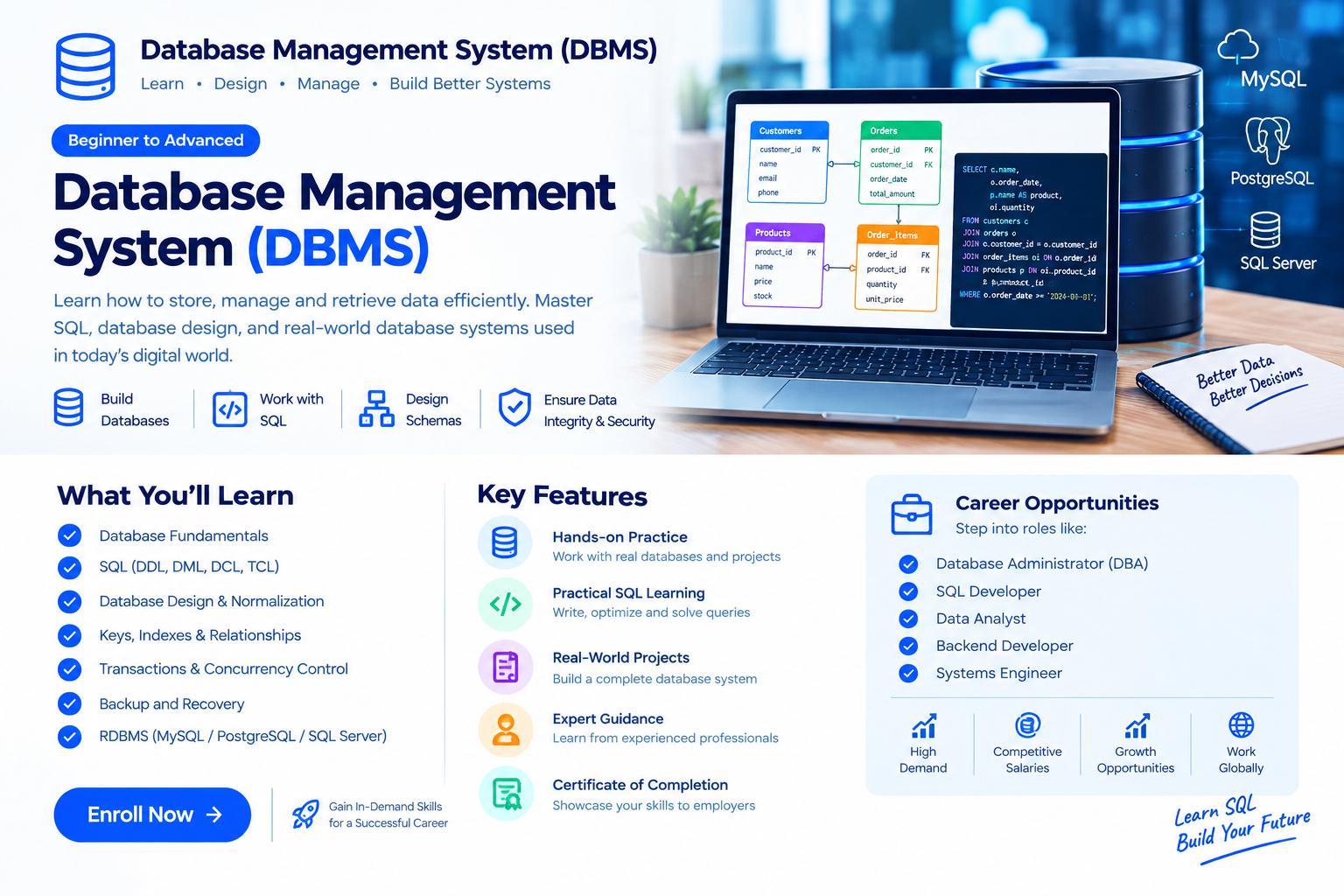
Course Overview
Overview: Teaches the theoretical design and practical execution of modern data storage systems powering web, mobile, and enterprise software.
Key Benefits: Reduces data redundancy, enforces strict security rules, and maintains data consistency using ACID properties (Atomicity, Consistency, Isolation, Durability).
Core Topics are
- Entity-Relationship (ER) modeling and database normalization.
- Writing queries using Structured Query Language (SQL).
- Transaction management, concurrency control, and recovery mechanisms.
- Physical file organizations, indexing, and B-trees.
Outcomes: Equips students to design efficient schemas, optimize queries, and secure enterprise data for careers in software engineering and database administration.
Who This Course Is For:
Open to school students, college undergraduates, and career switchers. No prior coding required.
Course Key Information
Self Paced
Beginner
Open to school students, college undergraduates, and career switchers. No prior coding required.
What You Will Learn
Technologies Covered
Tools & Platforms Used:
Lesson Plans & Curriculum
All chapters and lessons are publicly accessible.
Chapter 1 — Introduction to DBMS
5 Lessons • Introduction to database management systems
Chapter 2 — Database Architecture and Models
5 Lessons • Database architecture and different database models
Chapter 3 — ER Model and ER Diagrams
5 Lessons • Entity Relationship model and ER diagrams
Chapter 4 — Relational Model and Keys
5 Lessons • Relational model and different types of keys
Chapter 5 — SQL Fundamentals
5 Lessons • SQL basics, commands and database operations
Chapter 6 — SQL Queries and Functions
5 Lessons • SQL queries, functions and expressions
Chapter 7 — Joins, Subqueries and Views
5 Lessons • Joins, subqueries and database views
Chapter 8 — Normalization
5 Lessons • Database normalization from 1NF to BCNF
Chapter 9 — Transactions and Database Security
5 Lessons • Transactions, concurrency and database security
Chapter 10 — Database Design and Practical Project
5 Lessons • Database design and practical DBMS project
Complete Your Project & Get Certified
Complete the final project, upload your work, apply for evaluation, and receive your certificate after approval.
1. Upload Your Project
Submit your completed project.
2. Apply
Apply for evaluation and certification.
3. Get Certificate
Receive your certificate after approval.
Course Completion Certificate
Shareable digital credential upon course completion
Complete the course requirements to receive your course completion certificate.
Start for Free
Access this course for free.
What's Included in this Course:
- 10 Course Chapters
- 50 Lessons
- Interactive Lesson Exercises & Notes
- Official Verified Digital Certificate
- Lifetime Access to All Course Materials